
Picking the right SUV for Montana life is not a casual decision. Between unpredictable winter storms, gravel forest roads, and highway stretches that seem to go on forever, the vehicle you choose has to perform when it counts.
The Subaru Forester and Honda CR-V are two of the most popular compact SUVs on the market, and Montana families frequently find themselves comparing both. Each has genuine strengths, but when you stack them against the specific demands of Big Sky Country, some differences start to matter quite a bit.
Why Montana Drivers Are Comparing the 2026 Subaru Forester and Honda CR-V
The 2026 Forester vs. CR-V conversation keeps coming up because both vehicles check the same initial boxes: family-friendly sizing, modern safety technology, solid fuel economy, and a reputation for long-term reliability. For drivers in Great Falls, Havre, or Choteau, those traits are a reasonable starting point. But Montana families tend to push their vehicles harder than suburban commuters do, and that's where the comparison gets more specific.
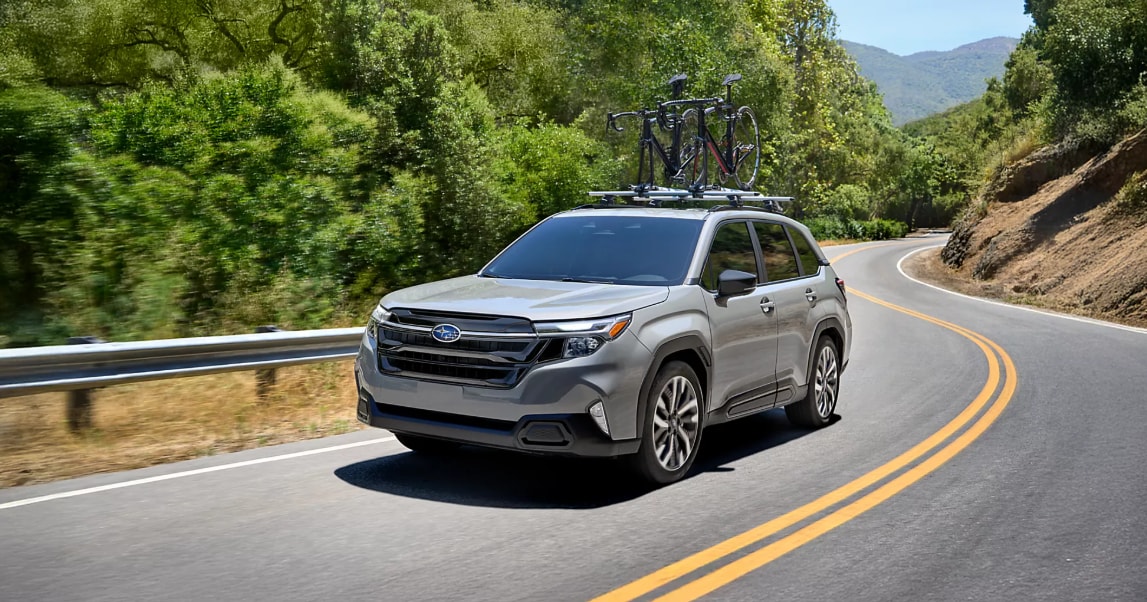
Looking at both side by side, their shared qualities actually mask some meaningful design differences. The CR-V leans toward a refined, comfortable daily driver experience. The Forester is built with tougher conditions in mind. If you'd like to see that difference firsthand, you're welcome to browse our new Forester inventory and schedule a test drive here in Great Falls.
AWD Systems: Standard Capability vs. an Available Upgrade
All-wheel drive is the most consequential feature in this comparison, especially where winter driving starts in October and sometimes doesn't let up until April.
Subaru's Standard Symmetrical AWD
Every Subaru Forester comes standard with Symmetrical All-Wheel Drive. No trim skips it, no configuration requires paying extra. Built around a longitudinally mounted engine and a fully symmetrical drivetrain, the system distributes power to all four wheels continuously, even before traction is lost. That balanced architecture improves stability, reduces torque steer, and keeps the vehicle planted on slippery surfaces.
For Montana families, this matters practically. When you leave our dealership in a Forester, AWD is already part of the package at every trim level.
Honda CR-V's Available AWD
The Honda CR-V offers AWD as an available upgrade on most trims. Base configurations are front-wheel drive unless buyers specifically select an AWD model. Real-Time AWD is standard on the TrailSport Hybrid and Sport Touring Hybrid trims, and Honda's system is reactive: it primarily operates in front-wheel drive and transfers power rearward when sensors detect wheel slip.
This works well in typical conditions. That said, reactive AWD means there's a brief lag before the rear wheels receive power, which matters on glare ice or loose gravel where you want traction before the slip happens, not after. On icy mountain passes like Rogers Pass, that distinction is very real.
Ground Clearance: Built for Snow, Gravel, and Montana Back Roads
Inside, the Forester's larger side and rear windows and thinner roof pillars create a broader field of view from the driver's seat, a real advantage when parking in tight spaces, navigating campground loops, or watching for hazards on mountain roads. Its cabin layout and durable interior materials reflect an outdoor-oriented design philosophy, making it easy to load and clean after hauling gear, muddy boots, or wet camping equipment.
The CR-V counters with a more polished interior aesthetic and slightly larger maximum cargo volume (76.5 cu ft vs. the Forester's 74.4 cu ft), well-suited to families who prioritize in-cabin refinement and urban-leaning design whose daily drives favor city commuting over backcountry access.
Outward Visibility and Interior Durability for Active Families
The Forester's larger side and rear windows and thinner roof pillars create a broader field of view from the driver's seat, a real advantage when parking in tight spaces, navigating campground loops, or watching for hazards on mountain roads, and its durable interior materials make it easy to clean after hauling gear, muddy boots, or wet camping equipment.
The CR-V counters with a more polished interior aesthetic and slightly larger maximum cargo volume (76.5 cu ft vs. 74.4 cu ft), an urban-leaning design sensibility that appeals to buyers whose daily drives favor city commuting over backcountry access.
Features, Safety Tech, and Value Side by Side
Both vehicles carry strong safety credentials. The 2026 Forester includes EyeSight® Driver Assist Technology, covering pre-collision braking, adaptive cruise control, and lane-keeping assist, standard across all trims. The CR-V includes Honda Sensing as a standard package with comparable collision and lane-assist functions. Head-to-head, both systems are effective and broadly comparable, making this category genuinely competitive.
Contact our team if you'd like to walk through the Forester's safety features in person.
| Feature | 2026 Subaru Forester | 2026 Honda CR-V |
|---|---|---|
| AWD System | Symmetrical AWD, standard on all trims | Real-Time AWD, available on most trims; standard only on TrailSport Hybrid and Sport Touring Hybrid |
| Ground Clearance | 8.7 in. standard; 9.3 in. (Wilderness trim) | 8.2 in. (AWD models) / 7.8 in. (FWD models) |
| Engine | 2.5L SUBARU BOXER® 4-cyl, 180 hp, 178 lb-ft torque | 1.5L turbo 4-cyl, 190 hp (gas); 2.0L hybrid, 204 hp |
| Fuel Economy | Up to 26 city/33 hwy mpg (gas trims) | 28 city/33 hwy mpg FWD (gas 28 city/33 hwy mpg FWD (gas); 40 city/34 hwy mpg (hybrid) |
| Safety Tech | EyeSight® Driver Assist standard; DriverFocus® | Honda Sensing standard |
| Off-Road Features | X-MODE® with Hill Descent Control (Dual-function X-MODE on most trims above Base) | Snow Mode (TrailSport Hybrid variant) |
Where the vehicles diverge is value relative to capability. At comparable trim levels, the Forester delivers standard AWD and higher ground clearance without requiring an upgrade. The CR-V can reach a similar capability level, but that typically means selecting a higher trim or paying for AWD separately.
Which SUV Is the Better Choice for Montana Families?
Weighing the full picture for Montana conditions, the Forester earns its position as the more capable choice for families who spend real time outside city limits. Standard AWD on every trim, 8.7 inches of ground clearance, X-MODE® terrain management with Hill Descent Control, and a drivetrain designed for continuous all-weather traction add up to an SUV that asks less of its driver when conditions turn difficult.
That said, this isn't a one-size-fits-all answer. Families who primarily drive paved roads and prioritize interior refinement will find the CR-V genuinely impressive. It's a well-built, comfortable SUV that handles most daily Montana driving without issue, provided you opt for an AWD-equipped trim.
Experience the Subaru Forester at Great Falls Subaru
For those leaning toward the Forester, we carry the full 2026 lineup here in Great Falls. Our Subaru-trained service team also provides certified maintenance, warranty support, and genuine parts locally, a real ownership advantage when you're not near a major metro.
View our current Forester inventory or reach out to us at Great Falls Subaru to schedule a test drive. A few miles on the roads outside Great Falls will answer the question faster than any spec sheet.
Categories:
New Inventory