
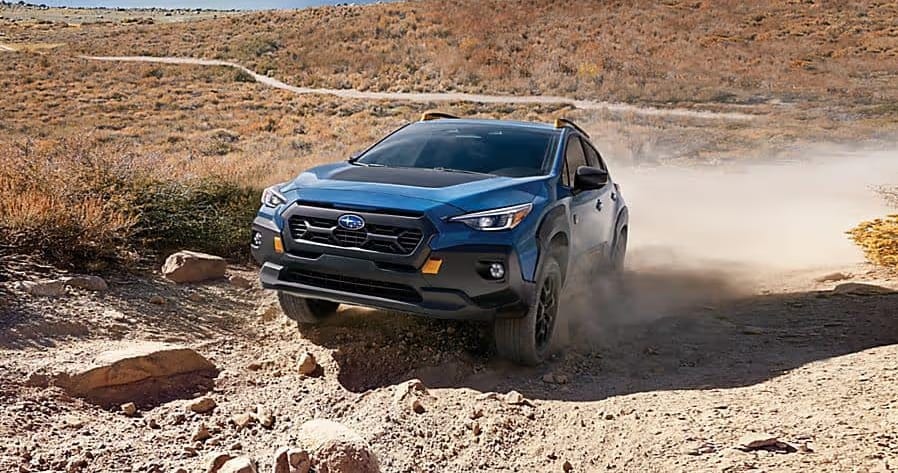
Montana doesn't ease you into its driving challenges. One mile you're cruising a dry interstate outside Great Falls, and the next you're threading a snow-packed two-lane with a mule deer frozen in your headlights. The state's sheer scale, brutal winters, and unpaved backroads don't just test your skills as a driver. They test everything your vehicle is built to do.
That's why the Subaru safety features Montana drivers rely on go well beyond airbags and seatbelts. If you're ready to see what's available, browse our new Subaru inventory to find a model equipped for Montana roads.
Why Montana Roads Demand More From Your Vehicle's Safety Systems
Montana is one of the largest states by land area in the continental U.S., and the distances between towns are not trivial. When something goes wrong on a rural stretch near Havre or Choteau, help isn't always close. That reality shifts safety from a marketing checkbox to a genuine necessity.
Beyond isolation, the road conditions themselves are punishing. Ice-glazed highways in January, gravel forest service roads in spring, sudden whiteouts in the high country, wildlife appearing without warning at dusk or dawn. All of it creates a driving environment where your vehicle's safety systems are asked to do real work. Drivers in this region need a vehicle that responds decisively when conditions deteriorate, not one that hesitates while waiting for driver input.
Subaru has built its lineup around exactly this kind of driving reality, which is why the brand resonates so strongly across rural western states. Understanding what these systems actually do, and why they matter here specifically, helps you make a smarter call when choosing your next vehicle.
Subaru Symmetrical AWD: The Foundation of Winter Safety in Montana
Most automakers offer all-wheel drive as an add-on or upgrade. Subaru builds its vehicles around it. Subaru's Symmetrical AWD is a full-time system, always active, always distributing power to all four wheels. It doesn't wait for a wheel to slip before engaging. It doesn't require you to flip a switch or select a mode. It simply works, continuously.
The "symmetrical" part refers to the drivetrain layout. The engine, transmission, driveshaft, and differentials are aligned along a central axis, creating balanced weight distribution across the vehicle. That balance directly improves handling, particularly through corners and during emergency maneuvers on slick pavement.
How Symmetrical AWD Outperforms Part-Time and On-Demand Systems
Part-time AWD systems operate in two-wheel drive by default and only engage the additional axle when wheel slip is detected. On-demand systems work similarly, relying on sensors to recognize a problem and then react. Both introduce a delay, brief but real, between the moment traction is lost and the moment the system responds.
On a dry road, that delay is largely irrelevant. On a black ice patch at highway speed outside Vaughn in February, it matters considerably. Subaru's full-time Symmetrical AWD never has to catch up because it's never switched off. Power delivery stays constant and balanced, so the vehicle maintains stability even before a slip occurs rather than scrambling to recover after one does. For Montana drivers upgrading from a truck or non-Subaru SUV, this distinction is worth understanding clearly.
Real-World Performance on Ice, Snow, and Unpaved Rural Roads
The practical difference shows up most clearly in the conditions Montana drivers encounter regularly. Packed snow on a mountain pass, rutted ice on a county road, loose gravel on a ranch access track. These all present traction challenges that a balanced, full-time AWD system handles more predictably than part-time alternatives.
Subaru vehicles also pair their AWD with Vehicle Dynamics Control, which monitors yaw and lateral movement and modulates braking and engine torque to keep the vehicle stable. On winding rural roads where the surface shifts from pavement to gravel mid-corner, that kind of continuous stability management provides a meaningful safety margin.
EyeSight Driver Assist Technology on Montana's Highways and Backroads
EyeSight is Subaru's driver assistance suite built around dual color cameras mounted near the rearview mirror. These cameras monitor the road ahead in real time, detecting vehicles, pedestrians, and potential collision scenarios. The system includes Pre-Collision Braking, Pre-Collision Throttle Management, Advanced Adaptive Cruise Control with Lane Centering, and Lane Departure & Sway Warning. Subaru has sold over 1 million EyeSight-equipped vehicles, and current EyeSight-equipped models receive the highest possible IIHS rating for front crash prevention.
What makes EyeSight especially relevant for Montana drivers is the nature of highway driving here. Stretches of US-89 or US-2 can run for an hour or more without a stoplight or significant intersection. That kind of monotonous, open-road driving is exactly where attention tends to drift, and where EyeSight's continuous monitoring provides genuine value.
Pre-Collision Braking and Throttle Management in Low-Visibility Conditions
One of EyeSight's most critical functions is Pre-Collision Braking. When the system detects an imminent collision and the driver hasn't responded yet, it can automatically apply the brakes to reduce impact severity or avoid a collision entirely. Paired with Pre-Collision Throttle Management, which prevents unintended acceleration, the system helps keep the vehicle under control even when reaction time is compromised by fatigue or reduced visibility.
Montana winters frequently produce whiteout conditions where visibility drops to near zero. In those moments, EyeSight keeps monitoring the road ahead, ready to intervene, providing a layer of protection that compensates for what human eyes can no longer reliably detect.
Adaptive Cruise Control Across Long Montana Stretches
EyeSight's Advanced Adaptive Cruise Control with Lane Centering automatically adjusts your speed to maintain a safe following distance from the vehicle ahead while helping keep the vehicle centered in the lane. On long highway runs, this cuts the cognitive load on the driver significantly. You set a comfortable speed, and the system handles the constant small adjustments as traffic conditions shift.
For drivers regularly traveling between Great Falls and Lewistown, or Great Falls and Browning, that assistance over a multi-hour drive is a practical tool for arriving alert rather than exhausted. Fatigue is a serious factor in rural highway accidents, and anything that reduces the sustained mental effort of long-distance driving contributes directly to safety.
X-MODE: Terrain-Specific Control When Montana Roads Get Unpredictable
Available on select trims of the Forester, Outback, Crosstrek, and Ascent, X-MODE pushes the AWD system's capabilities further by optimizing engine output, transmission behavior, and torque distribution specifically for low-traction terrain. Activating X-MODE adjusts how the vehicle manages wheel spin to maximize grip on surfaces that would challenge even experienced drivers.
Hill Descent Control is part of the X-MODE package on equipped models. On steep, muddy, or snow-covered inclines, it maintains a steady, controlled descent speed without requiring you to manually modulate the brakes. For anyone using forest service roads, ranch trails, or mountain access routes, this feature significantly reduces the risk of losing control on a downslope.
X-MODE doesn't replace driver skill, but it gives you a meaningful advantage in the moments when terrain becomes genuinely unpredictable. Mud, deep snow, loose rock, water crossings: these are all scenarios where the system's terrain-specific calibration makes a measurable difference.
Subaru's IIHS Safety Record and What It Means for Montana Drivers
The Insurance Institute for Highway Safety runs some of the most rigorous independent vehicle safety testing in the automotive industry. As of December 2024, Subaru has earned multiple IIHS Top Safety Pick awards across its lineup. This reflects a consistent pattern of real-world crash performance. The 2026 Subaru Forester earned Top Safety Pick+ status, the highest award tier IIHS offers.
For Montana drivers, those ratings carry specific weight. When an accident occurs on a remote highway far from emergency services, the structural integrity of your vehicle and the effectiveness of its restraint systems can be the deciding factor in injury severity. Choosing a vehicle with a strong IIHS record is one of the most straightforward ways to improve your odds in a serious crash.
Additional Awareness Features Built for Montana Winters and Wildlife
Beyond the core safety architecture, modern Subaru vehicles include a range of awareness and detection features that address Montana's most specific driving hazards.
Detection and Driver Monitoring Systems
Blind-Spot Detection with Lane Change Assist uses radar to alert drivers when a vehicle enters the blind spot, with enhanced alerts when another vehicle approaches at higher speed during a lane change. That's especially useful when passing on two-lane highways with limited sight lines.
Reverse Automatic Braking detects objects behind the vehicle and can apply the brakes automatically, which matters when backing up on unpaved ranch surfaces or in parking lots where accumulated snow limits visibility.
DriverFocus Distraction Mitigation System uses facial recognition technology to detect driver sleepiness or distraction and provides alerts before a lapse in attention becomes dangerous. On long rural stretches, that kind of monitoring adds real protection.
Low-Light Visibility and Wildlife Collision Mitigation
Steering-Responsive Headlights point in the direction of turning for better visibility around bends, and High Beam Assist automatically switches between high and low beams based on oncoming traffic. Both features are particularly valuable on unlit rural roads and mountain passes after dark.
Wildlife encounters deserve specific mention. Montana hosts substantial deer, elk, and antelope populations, and collisions with large animals are a real risk at dawn and dusk. No electronic system can guarantee you'll avoid a deer that jumps into your path at speed, but forward-detection systems and Pre-Collision Braking that initiates a response before you've fully processed what's happening can reduce impact speed and lower injury severity.
Browse Safety-Rated Subaru Models at Great Falls Subaru
Find Your Montana-Ready Subaru
We carry new Subaru models including the Outback, Forester, Crosstrek, Ascent, Legacy, and Impreza at our Great Falls location, along with a selection of certified pre-owned Subaru models that come with inspections, warranties, and CARFAX reports. Whether you're looking for a commuter vehicle that handles Great Falls winters or a capable rig for backcountry access, our team can walk you through which safety systems come standard and which are available as upgrades on each model.
Get in Touch With Our Team
We serve drivers from across the region, including Black Eagle, Belt, Ulm, Vaughn, Havre, Choteau, Lewistown, and Browning. Sales hours run Monday through Saturday from 8:30 AM to 7 PM.
To connect with us directly, visit our contact page or call (406)-998-6198. Montana roads don't get easier, but with the right vehicle, they get a lot more manageable.
Categories:
technologies