
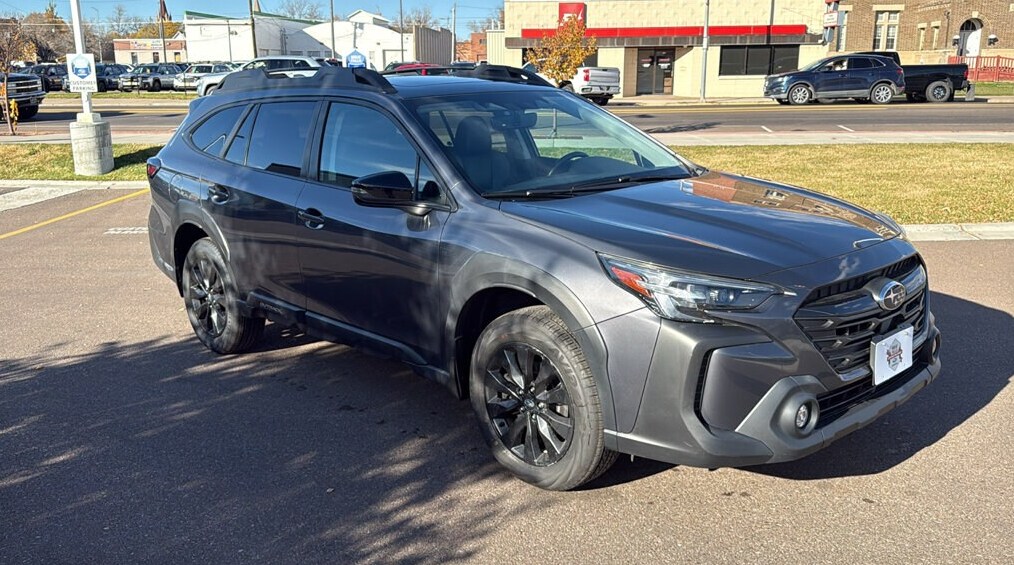
A used Outback can look great in a listing and still hide worn tires, skipped service, or equipment you assumed it had. We see it often at Great Falls Subaru, and most of it is easy to catch if you know what to look for.
This guide walks through the checks we recommend before you commit to a used Subaru Outback Great Falls MT shoppers can trust. When you're ready to compare, start with our used Subaru Outback inventory, where you can filter by year, mileage, and trim.
Why a Used Subaru Outback Fits Great Falls Driving
The Outback appeals to drivers who split time between commuting, errands, highway trips and weekends outdoors, combining passenger comfort, usable cargo space and all-wheel drive. AWD has been standard on every North American Outback since the 1997 model year, so nearly any used Outback you shop will have it, though the system, traction modes and related features have changed across generations.
AWD helps you get moving on slick surfaces, but it doesn't shorten stopping distances. Snow, ice and cold are also hard on tires, batteries and driver-assist sensors, and in Great Falls, road salt, de-icer and big temperature swings add to that wear.
Buying used also lets you compare model years and equipment levels instead of assuming the newest Outback fits best. Suitability depends on the individual vehicle's condition and maintenance history as much as the model's reputation. If you want a used AWD vehicle Great Falls roads can't easily rattle, the specific car in front of you matters more than the badge.
Start With Model Year, Trim, and Mileage
Treat model year, trim, and mileage as connected. A lower price can mean older technology, more wear, or maintenance coming due soon. Before you go further, confirm the exact vehicle by its VIN. It has 17 characters and appears on the driver-side dashboard (visible through the windshield), on your registration or insurance card, or on a plate inside the driver's doorjamb. Subaru's owner portal offers manuals and videos by VIN or by model year, model, and trim.
Why Features Vary by Generation and Trim
Most used Outbacks you'll find in Great Falls come from the four generations below, and equipment changes a lot from one to the next. Use the table to know what to look for, then confirm the exact vehicle's equipment by its VIN or its year and trim.
| Model Years | Engines and Transmission | Ground Clearance | Driver Assist | Max Cargo | Worth Checking |
|---|---|---|---|---|---|
| 2010–2014 | 2.5L 4-cyl., 170 hp (2010–12) or 173 hp (2013–14), 6-speed manual or CVT; 3.6L 6-cyl., 256 hp, 5-speed automatic | 8.7 in. | EyeSight available starting in 2013 (Pre-Collision Braking, Adaptive Cruise Control, Lane Departure Warning) | 71.3 cu ft | Which transmission it has, and whether it has EyeSight |
| 2015–2019 | 2.5L 4-cyl., 175 hp; 3.6L 6-cyl., 256 hp; CVT on all | 8.7 in. | EyeSight available 2015–2018, standard for 2019 | 73.3 cu ft | EyeSight on 2015–2018 models |
| 2020–2025 | 2.5L 4-cyl., 182 hp; 2.4L turbo, 260 hp (XT trims and Wilderness); CVT on all | 8.7 in.; 9.5 in. on Wilderness (2022 and later) | EyeSight standard; Automatic Emergency Steering available on 2023 | About 75.6 cu ft | 11.6-in. touchscreen on all but the base trim; dual-function X-MODE on Wilderness and Onyx Edition |
| 2026 (redesigned) | 2.5L 4-cyl.; 2.4L turbo available; CVT | 8.7 in.; 9.5 in. on Wilderness | Upgraded standard EyeSight; Hands-Free Assist on Touring and Touring XT; Emergency Stop Assist with Safe Lane Selection available | 80.5 cu ft | 12.1-in. touchscreen and 12.3-in. digital cluster standard on all trims |
Cargo figures come from different measurement standards over the years, so they're best for rough comparison. Subaru moved to a new method for the 2020 Outback.
Mileage and Engine Considerations for Montana Use
We don't use a universal mileage cutoff. Weigh mileage against the Outback's age, service documentation, previous use, and mechanical condition. Also look ahead to the next maintenance milestone, since a cheaper one may need money spent sooner than one with recent documented service.
Confirm the engine and transmission for the exact model year, and match them to how you drive. Estimated fuel economy and real-world results differ. Cold starts, short trips, speed, terrain, cargo, and tire choice all change consumption.
Review Vehicle History, Recalls, and Maintenance Records
Records tell you how an Outback was treated, which matters more than the odometer alone. The FTC advises shoppers to research the model, options, repair records, safety tests, and mileage before buying.
Vehicle History Report Red Flags
A history report can show ownership, accident, and repair history and salvage status. NMVTIS-approved reports cover title, insurance-loss, and salvage information, and other providers may add accident and repair history. NICB VINCheck can show whether a vehicle was flood-damaged, stolen but unrecovered, or declared salvage. Watch for:
-
Mileage entries that don't add up
-
Unexplained ownership changes
-
A mismatch between the listing and the report
-
Salvage or insurance-loss title information
If an Outback was a rental or fleet vehicle, ask about its maintenance instead of rejecting it automatically. Remember that "no accidents reported" only describes what a reporting service knows. A history report can't replace an inspection.
Check recalls by VIN on NHTSA's site. It shows unrepaired recalls, but it leaves out recalls already repaired, some very recent recalls before all VINs are added, recalls more than 15 years old, and non-safety manufacturer campaigns. Use both the history report and the NHTSA check.
AWD-Related Maintenance and Service Records That Matter
Subaru's drivetrain maintenance has changed over the years, so a used Outback's records should match its own model year's schedule. On a 2018 Outback, for example, Subaru calls for front and rear differential gear oil replacement and a CVT fluid inspection every 48 months or 60,000 miles, with axle boot and joint inspections every 24 months or 30,000 miles. From the 2019 schedule on, the differential gear oil and CVT fluid are inspected rather than replaced at that 60,000-mile interval, while the 2014 schedule lists CVT fluid and differential gear oil inspections at 60 months or 60,000 miles.
Look up the Warranty and Maintenance Booklet for the exact year and compare it with the service records, paying closest attention to these drivetrain items, since they matter most for AWD health. Our service center and Subaru Certified Technicians can help you read a record or answer inspection questions.
Inspect Tires, Brakes, Battery, and Underbody
Winter is hardest on these parts, so check them before you fall for the paint color.
Matching Tires and Tread Depth for AWD Health
The AWD tire rule is simple: use the same brand, the same size and similar tread depth on all four tires, since mismatched tires can strain the drivetrain. Your owner's manual explains Subaru's tread-matching guidance, and the driver-side Tire and Loading Information Label lists the correct size.
Tread must be at least 2/32 inch, but traction on wet and snowy roads drops well before that, so budget for new tires if the tread is near 4/32 inch. Check the tread and sidewalls for cuts, bulges and cracks, watch for irregular wear and inspect the spare. The last four digits of the DOT number show the production week and year, and some vehicle and tire manufacturers recommend replacement at six to 10 years regardless of tread. Check the pressure cold, meaning not driven for at least three hours, against the door label, since it drops as temperatures fall. Tires that suit summer may not give you the traction you want in snow.
Brake, Battery, and Rust Checks After Montana Winters
Slow or soft braking, or grinding or scraping noises, mean the brake system needs a check. Cold also cuts battery power, so have the battery and charging system tested, since AAA puts typical battery life at three to five years. Inspect the cables for tight connections and corrosion, and remember that a good start on a mild day is no proof of winter readiness.
Look underneath for damage or leaks around the fuel system, suspension, brakes, and exhaust. Winter salt and sand can contribute to rust where paint chips go untreated. Ask where the Outback lived before, since earlier road-treatment exposure affects corrosion risk. What you find usually falls into a few groups.
Light surface rust is worth noting, but corrosion on structural or safety-related parts needs a professional opinion. Uneven tire wear can point to alignment, suspension, inflation, or rotation problems, so budget for the fix. Any fluid leak under the Outback should be assessed by a technician.
Check the Interior, Cargo Area, Technology, and Safety Features
Sit in every seat and note any wear or odors. Check upholstery, carpets, and cargo surfaces for signs of moisture. Test the heat, air conditioning, defrosters, and heated seats if fitted. Pair your phone and try the touchscreen, audio, and charging ports.
Match the Outback to your life. If you haul gear, check cargo space and roof rails. For families, check rear seat room and LATCH anchors. For pets, look at the cargo area surfaces. Fold the rear seats and open the liftgate yourself. On a 2025 Outback, Subaru lists a retractable, removable cargo cover, grocery-bag and tie-down hooks, underfloor storage, a removable cargo tray, and rear-seatback release levers. Verify what an older one actually has.
Driver assists such as EyeSight Driver Assist Technology are available only if equipped by year, so confirm them on the exact Outback. Subaru's EyeSight materials state it may not operate optimally in all conditions and that the driver remains responsible. Check the warning lights, know whether the Outback has antilock brakes, and test the headlights, brake lights, turn signals, flashers, wipers, and defrosters. If a windshield or collision repair happened, ask about camera or sensor calibration.
Use This Used Outback Test-Drive Checklist
A short drive won't prove reliability. It will tell you what to ask an inspector.
-
Ask for a cold start and note the starting behavior, warning lights, and unusual noises.
-
Drive a safe route with city streets and highway speeds to judge acceleration, ride, steering, and cabin noise.
-
Pay attention to transmission behavior while accelerating and slowing, and have any hesitation or shuddering evaluated.
-
Confirm the steering feels predictable and the Outback tracks reasonably straight.
-
Apply the brakes progressively in safe conditions and watch for pulling or vibration, and note any grinding.
-
Make slow turns in a suitable area and listen for clicking, clunking, or binding.
-
Recheck for warning messages, unusual smells, and visible leaks after the drive.
A tire-pressure warning light calls for a pressure and leak check, and a check-engine light warrants a diagnostic inspection. The FTC recommends an independent mechanic's inspection with a written report naming the make, model, and VIN and estimating repair costs, even on certified or warranted vehicles.
Compare CPO and Other Pre-Owned Options at Great Falls Subaru
Subaru's Certified Pre-Owned program covers Outbacks 5 model years or newer with 80,000 miles or less that pass a 152-point inspection by Subaru Certified Technicians. Certified vehicles include factory-backed 7-year/100,000-mile powertrain coverage from the original in-service date, 24/7 roadside assistance and a CARFAX Vehicle History Report. At Great Falls Subaru, we add a 3-day or 300-mile money-back guarantee and a 7-day or 700-mile exchange promise.
For non-certified Outbacks with 45,001 to 100,000 miles, our Silver Guarantee includes a 30-day or 500-mile limited powertrain warranty, a 71-point inspection, a vehicle history report, any remaining factory warranty, a lube, oil and filter service, a full tank of gas and professional detailing.
Certification and coverage apply vehicle by vehicle, so confirm them on the Outback you like and read the written terms before you buy. Browse our certified inventory, then widen your search with our used Subaru SUV inventory for more range in age, mileage and equipment.
Browse Used Outbacks and Schedule Your Test Drive
Start with the used Subaru Outback Great Falls MT drivers can see in person, and build a shortlist using the same criteria for each one. Our used Subaru Outback inventory filters by year, mileage, and trim. Confirm the Outback's physical location first, since online results can include distant listings.
To schedule a drive, call us at 406-727-2100 or contact us online. We're at 800 Central Ave. in Great Falls. Our sales team is available Monday through Saturday until 7 p.m., and our service department is open Monday through Friday from 7:30 a.m. to 5:30 p.m. and Saturday from 8 a.m. to noon.
Categories:
Tips