
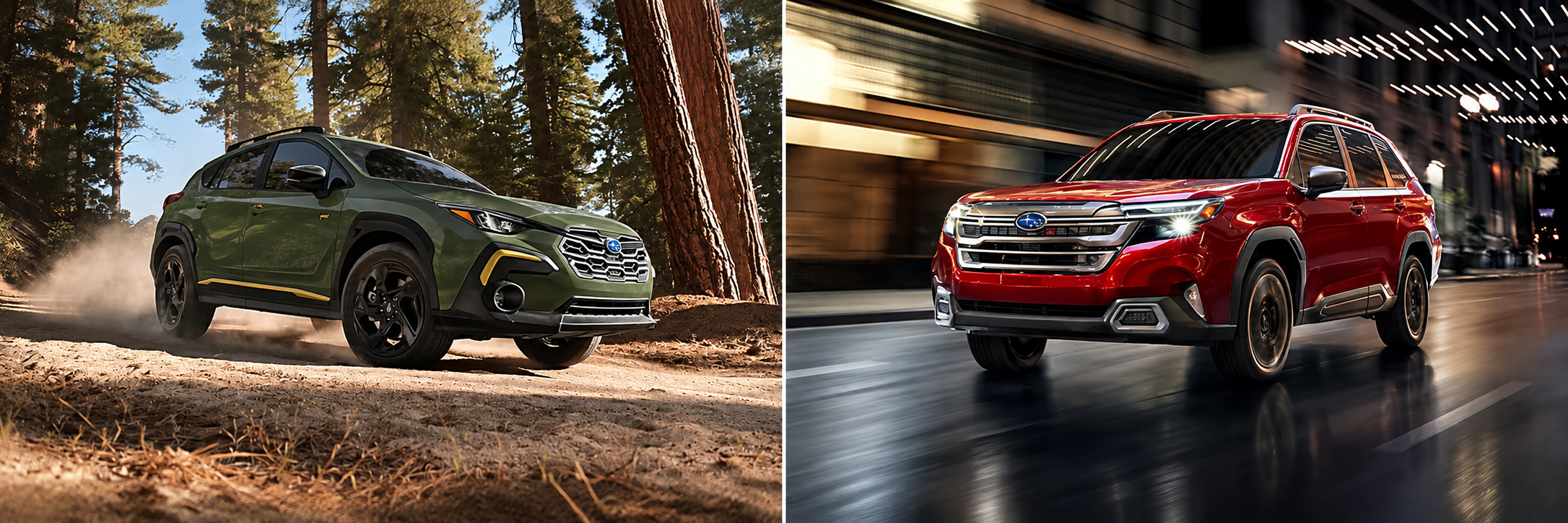
If you're weighing the 2026 Subaru Crosstrek vs Forester, you're really choosing between easier parking and more room. Both come with Symmetrical All-Wheel Drive (AWD) on every trim, and both handle an icy Great Falls commute well. We'll help you sort out which one fits your routine, and you can browse our new inventory as you read.
2026 Subaru Crosstrek vs. Forester at a Glance
This Subaru SUV comparison for Montana covers the 2026 gas models. Both use the same 2.5-liter SUBARU BOXER engine and the same standard EyeSight driver-assist system, so the real differences come down to size and cargo layout, plus what each trim includes.
Side-by-Side Specs Overview
| Spec | Crosstrek | Forester |
|---|---|---|
| Engine/powertrain | 2.5-liter SUBARU BOXER | 2.5-liter SUBARU BOXER |
| Drivetrain | Symmetrical AWD, standard | Symmetrical AWD, standard |
| Horsepower/torque | 180 hp / 178 lb-ft | 180 hp / 178 lb-ft |
| Fuel economy (hwy/city) | 33/26 (Base, Premium, Sport, Limited); 29/24 (Wilderness) | 33/26 (Base, Premium, Limited); 32/25 (Sport, Touring); 28/24 (Wilderness) |
| Length / height | 176.4 in. / 62.8 in. | 183.3 in. / 68.1 in. |
| Ground clearance | 8.7 in.; 9.3 in. (Wilderness) | 8.7 in.; 9.3 in. (Wilderness) |
| Cargo volume (seats up/down) | 19.9/54.7 cu. ft.; 20.0/54.9 (Wilderness) | 29.6/74.4 cu. ft. (Base); 27.5/69.1 (all other trims) |
| Max. load floor length (seats up/down) | 32.1/63.9 in. | 36.5/70.7 in. |
| Passenger volume | Up to 100.5 cu. ft. (99.0 with moonroof) | 110.8 cu. ft. (Base); 106.6 (other trims) |
| Towing | 1,500 lb; 3,500 lb (Wilderness) | 1,500 lb; 3,500 lb (Wilderness) |
Since the engines match, the numbers that matter are the ones that differ. The Forester is 183.3 inches long against the Crosstrek's 176.4, and it stands about five inches taller on non-Wilderness trims. So which is bigger? The Forester, and you'll feel it most in the rear seat, where legroom is 39.4 inches versus 36.5.
Size, Passenger Room, and Cargo Space for Everyday Montana Life
Crosstrek vs. Forester size comes down to how you use the back half of the vehicle. The Forester gives you a higher seating position and more passenger and cargo space, while the Crosstrek's shorter, lower body has the edge in tight parking.
Exterior Footprint and Interior Comfort
The Crosstrek is lower and more compact, which helps in downtown lots and snowy driveways. The Forester's upright cabin gives you more headroom and a commanding view of the road. Passenger volume reflects that, at up to 100.5 cubic feet in the Crosstrek and 106.6 to 110.8 in the Forester. A moonroof trims the Crosstrek figure to 99.0.
In our view, the Crosstrek works well if you mostly ride solo or with one passenger. Anyone who regularly seats adults in back will be happier in the Forester. Sit in both before you decide.
Crosstrek vs. Forester Cargo Space for Skis, Camping Gear, and Grocery Runs
Start with seats-up volume, since that's what you have when the second row is occupied. The Crosstrek offers 19.9 cubic feet, and most Forester trims offer 27.5. For a week of groceries or a cooler and camp chairs, that gap is noticeable. A dog crate is a question of layout as much as volume, so measure yours.
Both have 60/40-split folding rear seatbacks, so you can carry a passenger and longer cargo together. The Crosstrek's load floor runs 32.1 inches with the seats up and 63.9 inches with them folded, while the Forester's runs 36.5 and 70.7 inches, with a rear gate opening up to 49.2 inches wide. That extra length matters for skis and longer camping gear, so bring yours to a test drive and see how it fits.
For Crosstrek owners with a ski rack, the moving-load crossbar capacity is 176 lb on Base and 165 lb on Premium, Sport, Limited, and Wilderness. Static roof-rail capacity is 700 lb on non-Base trims. A roof load frees interior space for passengers.
For Forester owners, the larger interior means you may need the roof less often. The taller cabin also gives you more room for bulky loads behind the rear seats.
This section suits the Crosstrek for light loads and the Forester for families and gear-heavy weekends.
Standard Symmetrical AWD, Ground Clearance, and Winter Driving
Both models share standard Symmetrical AWD, so winter comparisons hinge on clearance, traction modes, tires, and comfort equipment. Both sit 8.7 inches off the ground on non-Wilderness trims and 9.3 on Wilderness.
Traction on Snow, Ice, and Gravel Roads
AWD helps you get moving and manage whatever grip is available. Black ice stays black ice, though, and stopping distances don't get any shorter. Tires matter most for stopping, so talk to our service center about seasonal prep before the first snow.
X-MODE is where the models differ. Every Crosstrek has Dual-Function X-MODE with Snow/Dirt and Deep Snow/Mud settings, plus Hill Descent Control. On the Forester, the Base trim doesn't include X-MODE, Premium has single-mode X-MODE with Hill Descent Control, and Sport, Limited, Touring and Wilderness have Dual-Function X-MODE. The Forester Wilderness also adds Low Speed / Low Ratio Gradient Control for steep, slow terrain.
On a snowy gravel or forest-service road, that means any Crosstrek gives you the same traction setup, whatever trim you pick. The Forester matches its clearance, so if you drive rough roads often, look at Premium or above, and consider Sport or above if you want the Dual-Function settings.
Cold-Weather Features: Standard vs. Available by Trim
On the Crosstrek, the All-Weather Package (wiper de-icer, heated side mirrors and heated front seats) is optional on Premium and standard on Sport, Limited, and Wilderness. Limited and Wilderness also have a heated steering wheel as standard.
On the Forester, heated front seats, heated mirrors, and wiper de-icer are All-Weather Package equipment, so they vary by trim and package. The Limited adds a heated leather-wrapped steering wheel, and the Touring adds heated and ventilated front seats and heated rear outboard seats.
If cold mornings in Great Falls are your main concern, pick by trim. A Crosstrek Sport or above gives you simple, well-equipped winter comfort. The Forester Touring is the one to look at if rear passengers matter.
Ready to compare? Contact us and we'll help you match a trim to your winters.
Engines, Fuel Economy, and Towing Considerations
With identical 180 hp and 178 lb-ft ratings, don't expect the engine to decide this. Weight and calibration can still change how each feels on the road, so drive both. Fuel economy is close on most trims, 33/26 MPG highway/city on Crosstrek non-Wilderness trims and on Forester Base, Premium, and Limited. Forester Sport and Touring rate 32/25. Real-world figures shift with cold weather, short trips, and cargo load, and tire choice plays a part too.
Towing is 1,500 lb on Crosstrek Base, Premium, Sport and Limited, and most Forester trims are rated up to 1,500 lb. The Crosstrek Wilderness is rated at 3,500 lb, and the Forester Wilderness is also rated at 3,500 lb. A tow rating is only one requirement, so match your trailer's weight, hitch and braking needs to your exact vehicle.
This section suits light-duty haulers on either model, and anyone towing a small camper or trailer toward Wilderness.
Wilderness Options: Built for Outdoor Recreation
If you're comparing Forester Wilderness vs Crosstrek Wilderness, both bring 9.3 inches of clearance and all-terrain tires, 225/55R17 on the Crosstrek and 235/60R17 Yokohama GEOLANDAR on the Forester. They suit trails, forest roads, and recreation, and extreme rock crawling is outside their range.
Both Wilderness models use shorter 4.111 final-drive gearing for climbing power. The Crosstrek Wilderness adds a raised suspension, extra underbody protection and StarTex upholstery, with approach, departure and breakover angles of 20.0, 33.0 and 21.1 degrees. The Forester Wilderness comes with standard front underbody protection, all-weather mats and a cargo tray, with angles of 23.5, 25.5 and 21.0 degrees. That gives the Forester the better approach angle and the Crosstrek the much steeper departure angle, which helps when backing down off ledges or out of ruts. Both rate 3,500 lb for towing.
There are trade-offs. Fuel economy drops to 29/24 MPG on the Crosstrek and 28/24 on the Forester. Wilderness makes sense for drivers whose routes and activities call for it, which isn't every Montana driver.
Commuting, Family Use, and Weekend Adventures: Matching Each SUV to Your Routine
Build your choice around who rides with you and where you park, plus what you carry. The vehicle that handles Tuesday well often beats the one built for one big weekend.
Choose the Crosstrek If
-
You want a smaller footprint for tight parking and daily commuting.
-
Your passenger and cargo needs are modest, with folding seats for occasional extra room.
-
You want Dual-Function X-MODE with Hill Descent Control on every trim.
Our new Crosstrek models are a good place to start if Crosstrek Great Falls MT is on your list.
Choose the Forester If
-
You regularly use the rear seat and want its extra legroom.
-
You need more cargo space while keeping the second row open.
-
You prefer an upright cabin, and perhaps heated and ventilated seats on the Touring.
Browse our new Forester models if Forester Great Falls MT fits your life better. We also carry used and certified pre-owned options.
Explore Crosstrek and Forester Inventory and Schedule a Test Drive at Great Falls Subaru
You'll learn more comparing them in person. Bring your skis, a cooler or the dog crate so you can check cargo fit yourself, then try both rear seats and get a feel for parking. Browse our Crosstrek and Forester inventory to see what's on the lot today, or schedule a test drive and we'll have both ready to compare. Visit us at 800 Central Ave. in Great Falls, or call 406-727-2100.
FAQs About the Subaru Crosstrek and Forester in Great Falls, MT
Which is bigger, the Forester or the Crosstrek? The Forester. It's 183.3 inches long on non-Wilderness trims against 176.4 for the Crosstrek, with more passenger and cargo volume.
Is AWD standard on both? Yes. Symmetrical AWD is standard on every trim. It helps traction, but winter tires still matter for stopping.
Which gets better fuel economy? It depends on trim. Both reach 33/26 MPG highway/city on several trims, while Wilderness rates 29/24 on the Crosstrek and 28/24 on the Forester.
How much can they tow? Crosstrek Base, Premium, Sport, and Limited are rated at 1,500 lb, and most Foresters are up to 1,500 lb. Wilderness is 3,500 lb on both.
Is Wilderness worth it? It adds 9.3 inches of clearance and all-terrain tires for trails and forest roads. It costs some fuel economy, so match it to how you really drive.
Do hybrids exist? Yes. Both models have hybrid versions with their own specs, separate from this gas-model comparison. Ask us about them.
Categories:
Vehicle Comparisons